What Is the Connection Between Abacus and Mental Maths?
Many parents have asked themselves how some children are able to compute complex calculations quickly, without using a calculator, and without even writing anything down. The key is to understand the relationship between abacus and mental maths.
Abacus is not only a counting device — it is an effective learning system that lays the basis for mental arithmetic. Over time, children move from using physical beads to performing calculations in their minds with speed and accuracy. This is how abacus learning is one of the best methods to build mental calculation proficiency, confidence, and concentration.
In this blog we will examine the relationship between abacus and mental maths, and why it is a trusted approach used by educators and parents around the world.
Understanding the Abacus
What Is an Abacus?
Abacus is a simple instrument with beads and rods for making calculations. It may seem simple, but it is a great help in building children's number sense and logical thinking.
How Children Learn with an Abacus
Children first learn to place beads to represent numbers. They slowly learn addition, subtraction, multiplication, and division with the abacus. This practical technique enhances their number sense and provides the foundation for abacus education for children.
What Is Mental Maths?
Definition of Mental Maths
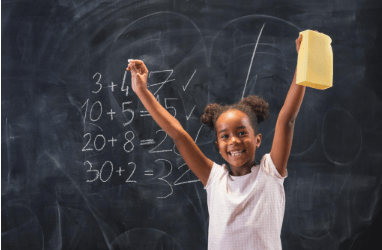
Mental mathematics is calculating problems without paper, pen, or calculator. It requires strong memory, concentration, and visualization.
Everyday Uses of Mental Maths
Mental maths is not confined to the classroom — it is used every day in children's lives, for example:
- Using money to buy things
- Calculating time or distance
- Solving sums quickly in exams
- Managing pocket money
Good mental maths skills develop children's thinking and confidence to solve problems.
How Abacus Leads to Mental Maths
The connection between abacus and mental maths occurs in three key phases:
Physical Bead Movement
Children use a physical abacus to perform calculations, enhancing hand-eye coordination and number concepts.
Visualization
Children start to picture the abacus in their minds. They visualize bead movements without needing the physical tool.
Mental Calculation
Children use their imagination to move beads and perform calculations entirely in their heads — with speed and accuracy.
This smooth transition shows how abacus naturally evolves into mental maths — turning a physical tool into a powerful mental skill.
Want Your Child to Master Mental Maths?
AVAS Abacus offers structured, step-by-step programs that take children from bead counting to lightning-fast mental calculation.
Explore Abacus ProgramsThe Advantages of Abacus Learning for Mental Maths
Abacus training provides long-term benefits beyond just calculation:
⚡ Faster Arithmetic Skills
Children are able to solve problems efficiently and effectively at speed.
🎯 Improved Concentration & Memory
Focusing and memorizing are strengthened through regular training sessions.
🧠 Cognitive Development
Both the left and right brain are stimulated, enhancing general thinking skills.
🔢 Stronger Number Sense
Children grasp numbers deeply rather than just memorizing formulas.
💪 Increased Confidence
Immediate resolution of problems helps improve self-confidence in school work and everyday life.
👁️ Visualization Skills
Children develop the ability to picture numbers and operations in their minds clearly.

Why Visualization Is the Key
The link between abacus and mental maths is visualization. The child's brain becomes engaged in both creative and analytical areas when using imagination to visualize the abacus.
This technique helps with:
- Retaining information longer
- Solving problems without hesitation
- Enhancing speed and accuracy
The learning process on the abacus is visual learning — rather than memorization.
Abacus vs Traditional Mental Maths
| Aspect | Abacus-Based Learning | Traditional Mental Maths |
|---|---|---|
| Learning Method | Visual + Practical | Mostly Memorization |
| Speed | Faster with practice | Moderate |
| Understanding | Deep conceptual clarity | Often surface-level |
| Brain Development | Whole brain activation | Limited |
| Engagement | Interactive and fun | Can feel repetitive |
This comparison clearly shows why abacus and mental maths together provide a more effective learning experience.
How AVAS Abacus Makes Mental Maths Easy
At AVAS Abacus, the emphasis is on step-by-step, structured, and results-focused mental maths learning.
- Structured Learning — A good curriculum ensures strong progression from basics to advanced
- Interactive Teaching Methods — Children enjoy learning and classes are always engaging
- Experienced Trainers — Expert trainers help students using effective, proven methods
- Regular Practice — Consistent sessions allow children to become faster, more accurate, and more confident
This way, AVAS Abacus ensures that children not only learn maths — they succeed at it. For certified abacus teacher training, explore IIVA as well.
Tips for Parents
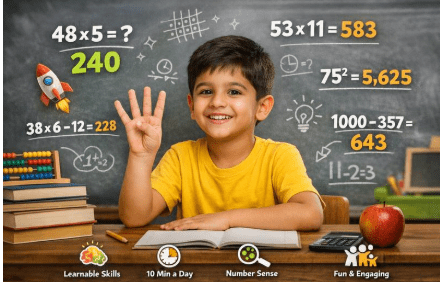
Here are some simple tips if your child needs to benefit from abacus and mental maths:
- Practice regularly at home
- Avoid over-reliance on calculators
- Appreciate your child's progress
- Select programs from a structured approach such as AVAS Abacus
- Use a variety of learning activities that are fun and non-stressful
Your support is an important part of your child's learning journey.
Common Misconceptions
Only young children use abacus.
✅ FactAbacus training is best started at a young age but can be very beneficial to older children too.
Mental maths is only about memorizing.
✅ FactMental calculation using abacus is built on understanding and visualizing — not memorization.
Mental maths is not needed when using a calculator.
✅ FactStrong mental maths skills help children use calculators better and be faster, more accurate, and more confident in real-world situations.
Final Thoughts
The connection between abacus and mental maths is clear and powerful. Mental maths is built on the foundation of abacus. Together, they help children develop quicker arithmetic skills, better concentration, stronger memory, and greater confidence.
These skills are not just beneficial in today's competitive world — they are a necessity. Parents can provide their children with an academic edge and lifelong learning abilities through a structured programme such as AVAS Abacus.
Abacus is the ideal tool for helping your child think faster, learn better, and grow smarter.
Start Your Child's Abacus Journey Today
Give your child the tools to think faster, calculate smarter, and build lifelong confidence in mathematics with AVAS Abacus.
Find an AVAS Center Near You