
How Teachers Can Make Maths Practice More Engaging for Young Learners
Mathematics is the base of analytical thinking, problem-solving and logical reasoning. But for a lot of young students, the subject can feel dull and frightening. Maths practice can become a daily chore rather than an exciting discovery process when it relies on traditional drills, worksheets and endless rote calculation.
Children who lose their positive attitude toward maths in the early years often develop anxiety that follows them throughout their school career. To change this dynamic isn't to give up on core practice — it's to look at how that practice happens. Engaging approaches to maths instruction can help students learn more effectively while keeping their curiosity alive.
This guide introduces practical, research-backed strategies to make children's maths practice more dynamic, effective and rewarding.
Why Traditional Repetition Doesn't Always Work
Rote repetition has been used to develop basic numeracy skills for a long time. Repetition is important for developing fluency, but mechanical drill work frequently fails to engage young learners for several reasons:
Brain Fatigue
Young minds have short attention spans. A seven-year-old asked to complete 30 near-identical arithmetic problems on one sheet will burn out before learning.
Without Context
Numbers on paper seem removed from reality. Without context, children learn steps rather than concepts — and cannot transfer that knowledge to new situations.
Fear of Failure
Standard worksheets draw attention to errors in red ink, creating high stakes around basic practice. This environment creates stress rather than building strength.
Passive Engagement
Sitting and completing answers is not how young children learn best. They need to interact, move, discuss, and discover — not receive.
Real fluency requires teachers to engage multiple senses and create an interactive learning environment where motivation is maintained over time.
8 Ways to Make Maths Practice More Interesting
You don't need to change everything in your classroom. When you put these eight practical strategies into practice, maths class becomes a lot more engaging for young learners.
Turn Practice Into Short Challenges
Rather than giving a long sheet of 20 identical problems, make it a short-term challenge. Brief, focused activities avoid mental overload and set a positive tone for the session.
- Beat the Clock: Give students 60 seconds to work through as many problems as they can comfortably finish. Avoid comparing scores within the class — the competition is with their own previous time.
- Mystery Codes: Assign a letter to each number answer. As children work through the problems, their answers form a secret message or joke.
- Target Numbers: Provide 3 or 4 numbers and a target (e.g., use 2, 4 and 5 to make 10). This shifts the focus from calculation to creative strategy.
Use Visual Learning Tools
Young learners think concretely before they can reason abstractly. Visual aids bridge this gap and help children form clear mental images of numerical relationships.
| Visual Tool | Practical Classroom Application | Learning Benefit |
|---|---|---|
| Ten-Frames | Students represent numbers using counters inside a 2×5 grid | Builds spatial awareness and strong number bonds to 10 |
| Number Lines | Children physically step forward or backward on a floor mat number line | Connects arithmetic operations directly to physical movement |
| Base-10 Blocks | Use units, rods and flats to represent place value during addition or subtraction | Transforms abstract place value into tangible, visible structures |
Introduce Mental Maths Games
Mental calculation doesn't have to be a tense drill. Dynamic maths games make quick calculations genuinely fun while developing real number fluency.
- Buzz/Fizz-Buzz: Students count sequentially around the room, replacing multiples of a chosen number (e.g. 3) with the word "Buzz." This builds pattern recognition and multiplication fluency naturally.
- I Have, Who Has?: Students hold cards with statements like "I have 12. Who has 12 minus 5?" The child with 7 replies "I have 7. Who has 7 times 2?" — the entire class stays engaged and listening throughout.
- Number Detective: Clues are given sequentially: "I am an even number, bigger than 20 but smaller than 30, and the sum of my digits is 8." Students eliminate options on a number chart until they find the answer.
Use Real-Life Examples
Children engage best with maths through activities that are happening around them. Connecting tasks to real-life situations removes the "why do I need to know this?" barrier.
- Classroom Shop: Set up a small shop using items from around the class and price tags. Students practise addition, subtraction and calculating change using play money as customer and cashier.
- Recipe Scaling: Bring a simple recipe to class and have students calculate ingredient amounts when doubling or halving it — real fractions with a real purpose.
- Data Collection: Have children poll classmates about favourite colors, animals or sports, then create bar graphs and pie charts from the results.
Encourage Pair and Group Activities
Working alone can be isolating. Collaborative maths activities enable peers to build numeracy together while developing mathematical communication skills.
- Peer Checking: Have students work in pairs to check solutions — but ask them to justify their answer rather than simply checking whether it is correct.
- Maths Dice Relays: Break the class into small groups. Students take turns at a station, rolling two dice, calculating the sum or product, recording the result and passing to the next player.
- Cooperative Problem-Solving: Give multi-step word problems to small groups, with each student assigned a role (Reader, Visualiser, Calculator, Presenter) so that everyone is accountable.
Create Progress Milestones
Children grow best when they can see results from their effort. Visual tracking systems keep motivation consistent, especially through difficult topics.
- Skill Tree / Sticker Charts: Create a class chart for each skill (e.g. 5 times tables, double-digit addition) and add a sticker when a student masters it.
- Personal Growth Journals: Have students track their personal bests over time — comparing against their own previous performance, not against classmates.
- Leveling Up: Organize activities like levels in an adventure game: "Complete single-digit facts to unlock Level 2: Word Problems."
Introduce Classroom Games
Competition can energize a classroom, but needs to be structured carefully so that weaker students are not discouraged. The goal is participation, not ranking.
- Team-Based Scavenger Hunts: Scatter maths problems around the room. Teams find and solve them, receiving points for both speed and a correct explanation of their method.
- Class vs. Teacher: See if the whole class can complete a series of mental arithmetic problems without making errors. If they get 85% correct, the class scores a point — if not, the teacher does.
- Self-Referential Contests: Challenge students to improve their own score from last time — removing the element of ranking others entirely.
Give Children Choice and Ownership
Giving students autonomy — even within clear limits — significantly increases investment in learning. When children feel they have a say, they engage more deeply.
- Task Menus: Provide 4 practice options to choose from (e.g. online puzzle, block-building challenge, word problem creation, mini-worksheet). Students pick based on how they learn best that day.
- Create-Your-Own Problems: Ask students to write word problems for classmates to solve. Building a question requires a deeper understanding of the concept than simply answering one.
- Format Flexibility: Allow learners to demonstrate their answer using drawings, physical blocks or written numbers — whatever form of expression suits them.
Balancing Fun With Real Learning
An activity can be so engaging that it drifts away from its core learning objective. Keep these principles in mind when designing or selecting maths activities:
Keep the Maths Front and Centre
A game should not be winnable by luck or speed alone — it should require mathematical thinking. If a child can win without doing any calculations, it is not a maths activity.
State Clear Learning Outcomes
All activities must be directly linked to a curriculum objective. Ask yourself before starting: "What mathematical skill is this activity developing?"
Include Reflection
At the end of every interactive session, take two minutes to debrief. Ask: "What strategy did you use?" or "What got you stuck and how did you get unstuck?"
Transition Smoothly
Set clear expectations before any activity begins. Establish signal words or quiet cues that allow you to return to instruction quickly after a group game ends.
Common Mistakes Teachers Should Avoid
⏱️ Relying Too Heavily on Timed Tests
Speed drills can be stressful for children who work carefully but slowly. Reward strategy and accuracy — not just quickness.
🎮 Using Games as Pure Fillers
Activities should be integrated with learning objectives — not used as rewards for completing "real" work. Games done right are the real work.
📊 Lack of Differentiation
One activity level given to a mixed-ability class will frustrate struggling students and bore advanced ones. Always prepare simplified and extended variations.
✅ Rewarding Only Correct Answers
Celebrate reasoning, effort and creative process — not just the final number. A student who tries a creative method deserves recognition even if their arithmetic has a small error.
How Abacus and Vedic Maths Activities Can Support Engagement
Incorporating structured techniques like Abacus and Vedic Maths is one of the most effective ways to diversify how maths is taught to young learners. These frameworks make abstract arithmetic concrete and mental.
The Power of Abacus Training
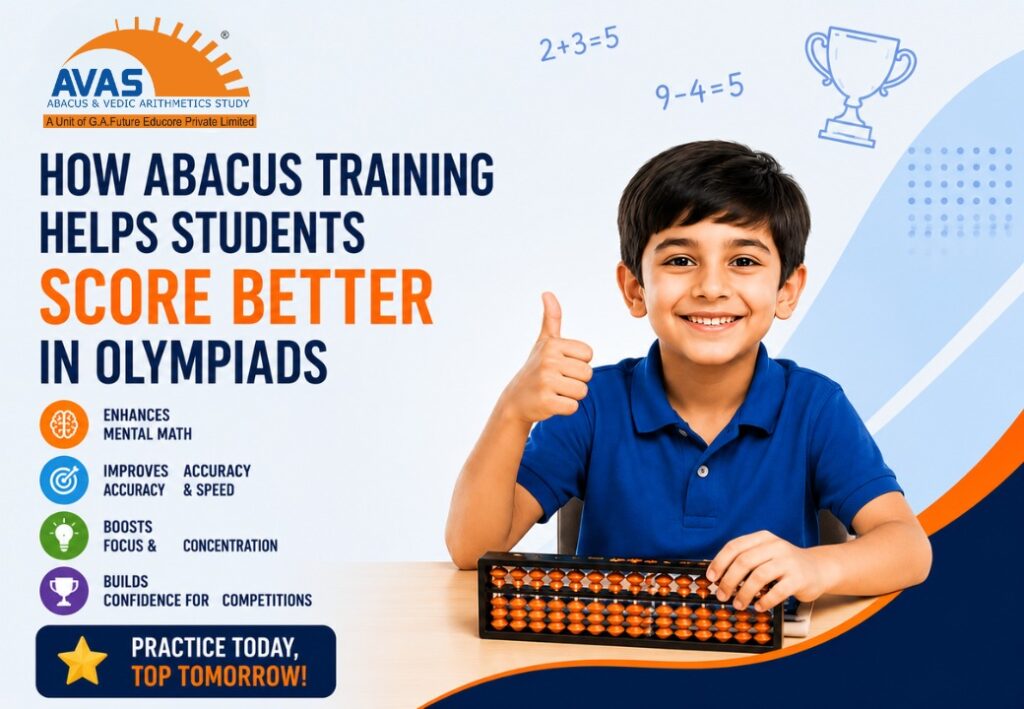
- Tactile Engagement: Children use physical bead movement to solve addition and subtraction, keeping kinesthetic learners fully engaged
- Mental Image Formation: Students gradually move from physical frames to mental abacuses, developing strong spatial imagery skills
- Extended Attention: The brain coordinates visual, auditory and motor pathways when operating an abacus — naturally extending a child's focus span
Flexibility of Vedic Maths
- Multiple Problem-Solving Paths: Students see that maths is not fixed — the same problem can be approached in several valid ways
- Rapid Calculation: Shortcuts for multiplying two-digit numbers or calculating squares make difficult problems feel satisfying rather than daunting
- Confidence Boosting: Mental shortcuts empower young learners to demonstrate skills they can clearly feel themselves mastering
A Sample 30-Minute Engaging Maths Session
Here is a simple, pre-designed approach to structuring a high-energy lesson on basic addition and number bonds:
Sample Session: Basic Addition & Number Bonds
Warm-Up: "Target 15" Mental Drill
The teacher calls out a number from 1 to 14. Students immediately respond with the complement needed to reach 15 (e.g. teacher says "7", students respond "8!").
Goal: Energize pre-learning without paper or pencil. Wake up mental arithmetic pathways.
Visual Concept Exploration: Ten-Frame Construction
Give students ten-frame cards and counters in two colors. Present a word problem (e.g. "Sam has 6 apples and finds 5 more"). Students use ten frames to make 10, then place the remaining counter outside the frame — visually showing that 6 + 5 = 10 + 1 = 11.
Goal: Ground abstract addition in concrete spatial reasoning.
Interactive Group Practice: "I Have, Who Has?" Card Chain
Place cards around the room and start the chain. See how fast the whole class can complete the loop without losing focus or breaking sequence.
Goal: Build mental calculation speed with active group coordination and class-wide listening.
Reflection & Cool Down: Strategy Share
Two or three students share one mental strategy or visual cue that helped them during the session. Others listen and add their own variations.
Goal: Consolidate learning through verbal explanation before moving on.
You don't need the latest technology or expensive materials to make maths practice genuinely engaging. With variety, visual aids, healthy group dynamics, and structured methods like Abacus and Vedic Maths, teachers can turn routine practice sessions into experiences young learners actually look forward to.
Train to Teach Maths the Right Way — with AVAS & IIVA
Structured teacher training in Abacus and Vedic Maths — covering teaching methodology, classroom engagement techniques, student assessment, and NSDC-certified certification. No prior teaching degree required.
Explore Teacher Training