
How AVAS Abacus Improves Mental Speed in Kids
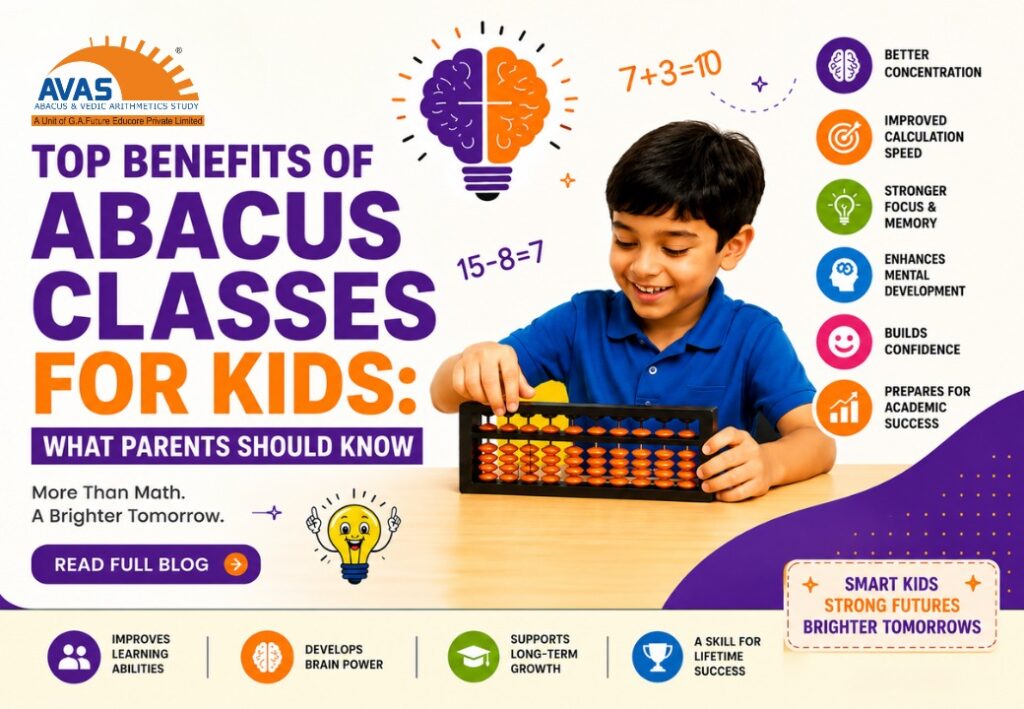
In the modern academic world (where children study at a very rapid pace), they are supposed to think fast, solve problems effectively and work even under time pressure. Competitive tests, exams, Olympiads, and even classroom testing, reward more and more speed, mixed with accuracy. Here the mental speed comes into play as a very important life skill, not only a mathematical skill. AVAS Abacus mental speed programs are aimed to make the children acquire quick calculations skills in the form of scientific, brain-based learning. Unlike the conventional math tuition, which is mostly about getting through the syllabus, AVAS Abacus fortifies the brain, a solid base given to lifetime education. The Reason Mental Speed is Important in the Contemporary Academic World Mental speed refers to the capacity to process information fast, correctly, and with certainty. In the case of children, the skill has a direct effect on Performance in timed exams Capacity to address problems in more than one step. Engagement and self-esteem in the classroom. Reduced exam anxiety Improved concentration and recall. Most children do not apply math concepts fast despite having the understanding about it. Such disconnect usually causes stress, self doubt and fear of mathematics. AVAS Abacus takes this problem at its source—it trains the brain to think visually, to compute and react quicker. The Science of AVAS Abacus Mental Speed training AVAS Abacus is developed based on the principles of brain-based learning, which is a combination of neuroscience and systematic mental math training. Whole Brain Development Via Abacus The conventional education stimulates mainly the left brain, which is the one that deals with language and logic. AVAS Abacus brings out both sides: Left brain: Accuracy, numbers, logic. Right brain: Visualization, imagination, pace. AVAS Abacus encourages development of the whole brain, as both sides are engaged at once so that children can calculate at a faster rate without losing accuracy. Calculation by Visualization: The essence of Mental speed Number visualization is one of the best differentiators of the AVAS abacus. Children are trained to: Imagine the abacus in his or her mind. Calculate without the use of material objects. Add and subtract numbers very fast. This visualization enhances neural connections, memory recall and calculation speed by far. This approach is much more productive than the rote memorization that has been implemented in the ordinary math tuition. The way AVAS Abacus enhances the speed of calculation step by step Gradual and Level-Wise Training AVAS Abacus is structured and level-oriented, and children can only proceed to the next level after mastering each one of them. Starts with physical abacus Slowly starts using mental calculation. Does not hurry with any pressure. This development guarantees no haste or inaccuracy in learning. Cognitive (Enhanced Concentration) in Children Abacus education requires attention, organization and concentration. Over time, children develop: Longer attention spans Better listening skills Faster response time Parents usually see the improvement in not only math but also in such subjects as science and languages. Creating Confidence in Math among Children It is not just about speed, but confidence is important. When children start adding more sums more quickly than the others, they feel: Reduced fear of numbers Increased classroom involvement. Positive self-belief This mathematical confidence among children is usually transferred to other fields of study and life. AVAS Abacus vs Standard Math Tutoring AVAS Abacus Normal Math Tuition Concentrate on mental pace and brain progression Concentrate on syllabus achievement. Learning by visualization Learning by memorization. Whole brain activation Left-brain learning, mainly. Enhances focus and self-esteem Deficient mental growth. Skills development over a long period of time Short-term preparation of exams. Brain Coordination and Development of Number Sense AVAS Abacus enhances number sense—the intuitive learning of numbers. Children learn to: Estimate answers quickly Conceptualize mathematical associations. Apply logic instinctively This brain coordination simplifies higher classes such as algebra, percentages and competition examinations. Benefits of real-Life Academic Parents Observe Parents who are AVAS Abacus enrolled usually report: Faster homework completion Increased performance in Olympiads. Improved exam scores Sharper memory and focus Between-group differences in enthusiasm. All these advantages make AVAS Abacus more than just an activity; it is a cognitive development program. The reason Parents will trust AVAS Abacus The Curriculum which is scientifically designed AVAS abacus adopts the best brain-based learning techniques that are in tandem with child psychology and cognitive development. From Structure to Transparency in learning Obvious levels, periodic evaluation, and observable progress are beneficial to parents to monitor progress. Holistic Child Development It is not just math; one improves concentration, confidence, speed and discipline. Training Young Children in More than Tests Mental agility will be an important factor in an age of AI and automation, where memorized information is less important. AVAS Abacus teaches children skills that will be useful in their lifetime: Quick decision-making Analytical thinking Stress management Confidence under pressure These are the competencies that make good students and leaders of tomorrow. Final Thoughts Speed of mind is not a choice anymore; it is an imperative. AVAS Abacus mental speed training enables children to acquire faster calculation skills in learning by visualization, whole brain activation, and practice. It is not like regular tuition, as it makes the brain stronger and enhances the ability of children to concentrate and the development of confidence in math that is permanent. AVAS Abacus is the right way to go in case you want your child to think faster, learn smarter and grow confidently.
How AVAS Abacus Improves Mental Speed in Kids Read Post »