Best Online Courses to Learn Abacus and Vedic Maths for Kids in 2026
The right mental arithmetic program for your child used to mean driving twice a week to a neighbourhood tuition center and hoping the teacher was experienced. That context has changed significantly today.
With the rapid evolution of virtual learning tools, parent demand for the best online abacus and Vedic maths courses for kids has skyrocketed. But switching from a physical classroom to a virtual one raises a new set of questions: Can a child really learn to manipulate beads through a screen? How do live online abacus classes keep a 6-year-old engaged? And how do you distinguish high-quality live training from a video-dump subscription that doesn't stick?
This guide cuts through the marketing jargon and gives you a clear framework to choose the best online math skill programs for your child in 2026.
Online vs Offline Abacus and Vedic Maths Classes
The online vs offline debate isn't just about convenience — it's also about how kids learn today and how busy modern families are.
🏫 Offline Center
- Only local/nearby teachers available
- Fixed class schedule — less flexibility
- Time spent commuting
- Mostly paper-based practice
- Periodic feedback (monthly/quarterly)
- Quality depends on local availability
- Limited parent visibility
💻 Online Class
- Best trainers in India at your fingertips
- Weekend and evening options — flexible
- Learn from home, no commute
- Digital tools + physical abacus combined
- Immediate feedback and real-time correction
- Consistent curriculum and outcomes
- Live tracking and parent updates
Master Trainers Available Anywhere
In offline channels, you can typically only access your local franchise branch — and teaching quality depends entirely on the teacher assigned there. Online, whether you live in a tier-1 metro or a remote town, your child can learn directly from master trainers and senior Vedic Maths scholars.
Flexible Scheduling and No Commute Stress
Children in 2026 are already managing demanding school schedules and extracurricular activities. Removing two hours of commuting per week means your child arrives at their screen fresh and focused — not tired from the journey.
Digital Tools as Complements to Physical Practice
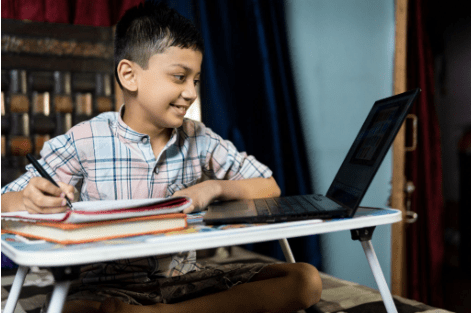
Good virtual math programs don't replace physical instruments — they complement them. The best abacus schools combine a high-quality physical abacus frame with digital interactive software, flashcards, and gamified speed drills to increase engagement while maintaining hands-on learning.
What to Look for in a Good Online Program
This is where parents make the most important decision. A few key factors separate a genuinely effective class from an hour of screen time that doesn't stick.
Live, Interactive Sessions vs Pre-Recorded Content
This is the single most important distinction. Abacus skill is built through repetition, real-time correction, and pacing — with the trainer watching the child's movements as they happen, stopping bad habits before they form, and adjusting speed as they improve. Pre-recorded videos cannot do any of that.
Live online abacus training means a real teacher is present, watching, correcting, and responding — just as in a classroom. If a program's primary offering is a video library, that's a red flag, not a feature. Serious abacus providers offer live sessions for exactly this reason.
Batch Size in a Virtual Classroom
Online doesn't automatically mean smaller classes — many providers pack more students in because there's no physical space limit. Ask directly: how many children are in each batch? A trainer can meaningfully engage with, correct, and encourage 8–12 kids in a live virtual session. Anything larger becomes a passive webinar, not a class.
Platform and Technology
The learning platform matters as much online as the classroom does offline. Ask:
- Does the video and audio quality allow the trainer to clearly see the child's abacus work?
- Are worksheets and practice materials sent digitally, or does the family need to print separately?
- Do the trainer and students share a whiteboard or on-screen abacus tool for demonstrations?
Good teaching can be undermined by a clumsy platform — a child who is struggling with lag or confusing screens is spending their mental energy on the technology, not on learning.
Progress Monitoring and Parent Transparency
One thing online programs can do particularly well is make progress visible. Since parents aren't physically in class, progress tracking — level completion, skill assessments, and regular trainer feedback — is how they know if their child is actually improving. If a program can't tell you clearly where your child stands after a couple of months, that's a red flag.
Certification
Check for recognised certification. NSDC or NCERT-affiliated certifications demonstrate that the curriculum is not fabricated in-house but aligned to an external, government-recognised standard. An NSDC-certified online abacus course is also typically a sign of a vetted provider — not just marketing.
Experience AVAS Online — NSDC Approved, Live & Interactive
Small batches, certified master trainers, and a structured dual-track abacus + Vedic maths curriculum — delivered live to your home.
Book a Free Trial ClassAbacus or Vedic Maths Online — Which Is Right for Your Child?
Parents often wonder whether their child should do abacus, Vedic maths, or both. Understanding the age range and core mechanics makes this decision straightforward.
🔢 Abacus — Ages 5 to 12
- Tactile learning using a physical 17-rod abacus tool
- Develops brain visualization skills
- Builds strong number sense and fundamentals
- Improves concentration and memory
- Ideal for young brain development
- Establishes the foundation for later calculations
📐 Vedic Maths — Ages 9+
- Based on 16 ancient Vedic sutras — no physical tool needed
- Shortcut techniques for multiply, divide, square, and simplify
- Faster and more precise problem-solving
- Directly useful in school tests and competitive exams
- Minimises calculator dependency
- Builds strong mathematical confidence
The Power of a Connected Pathway
These approaches are not mutually exclusive — leading schools offer both in combination. Children learn abacus first to develop visual concentration and basic arithmetic skills. From around Class 4–6, they transition to Vedic Maths to master faster mental calculations, competitive exam shortcuts, and complex school maths algebra tricks.
The combined abacus → Vedic maths pathway is the most complete mathematical development journey a child can take — from visual foundations at age 5 to exam-ready mental agility by age 12.
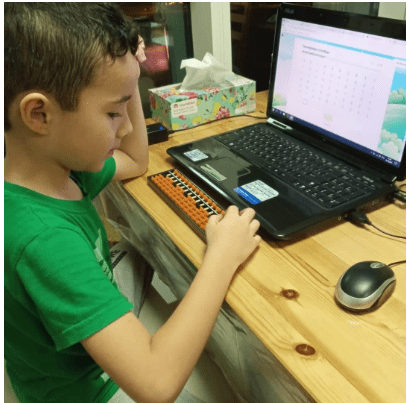
How to Make Online Learning Work for Your Child
A strong program is only half the equation — setting up your child's home environment to support success is equally important.
🏠 Dedicated Study Space
- Free from distractions and noise
- Proper desk and chair — not bed or sofa
- Camera at eye level for better interaction
- Good lighting and minimal background noise
- Laptop or tablet — not a smartphone (too small to see bead work)
📚 Session Preparation
- Have the abacus tool and notebook ready before class
- Print or arrange worksheets in advance
- Join on time with all equipment
- For abacus: angle the webcam slightly downward so the trainer can see both face and finger technique
⏱️ Daily Practice Routine
- 10–15 minutes of practice daily
- Consistency beats cramming — daily beats weekly
- Reinforce what was taught in class
- Avoid weekend-only sessions; mental math is a muscle built through daily use
Support Without Over-Intervening
In the first few sessions, parents may need to help younger children (ages 5–7) log in and set up their worksheets. Once the routine is established, step back and allow the child to develop independent problem-solving skills under the teacher's direction.
⚠️ Common Online-Class Red Flags to Avoid
- Too many children in a virtual room — A class of more than 12–15 students becomes a passive webinar where children are largely ignored
- No physical abacus required — If a provider says a young child doesn't need a 17-rod instrument at home to learn bead visualization, that's a red flag
- Self-paced recorded video subscriptions — Video libraries cannot provide live posture correction or speed drills, and have significantly lower completion rates with young learners
- No formal assessment — Programs that don't include timed assessments cannot determine whether students have actually met speed and accuracy standards

What Sets AVAS Online Programs Apart
In the field of abacus and Vedic maths skill development, AVAS (Abacus & Vedic Arithmetic Study) is one of the industry leaders — covering both the fundamentals and live online delivery. As an NSDC Skill India Approved Training Partner and NCERT Content Partner, AVAS delivers structured, government-accredited learning directly to your home.
The AVAS Online Advantage
- NSDC Approved & NCERT Partner — Government-affiliated, not a privately fabricated curriculum
- Integrated dual-track program — Abacus and Vedic Maths together in a single structured progression
- Micro batches — Small groups with close to 1-on-1 visual feedback from certified master trainers
- Age-specific tracks — Separate age-appropriate paths for Abacus (ages 5–12) and Vedic Maths (Class 4 onwards)
- Official level certification — Recognised certificate issued after each completed level, backed by the NSDC framework
- Complete learning ecosystem — Live demonstrations, structured physical practice workbooks, brain gym activities, and timed mock assessments
Frequently Asked Questions
Is online abacus training as effective as in-person classes?
Yes — with live interactive sessions and small batches. If a trainer can clearly see your child's physical abacus tool through the webcam and uses interactive digital speed tools, the outcomes can match offline learning, without the commute. The key is live instruction, not pre-recorded video.
What does my child need at home for online abacus or Vedic Maths classes?
For abacus: a standard physical student abacus frame, printed level worksheets, a laptop or tablet (not a smartphone — too small to show bead work), a reliable internet connection, and a webcam that captures the child's hands. For Vedic Maths: a notebook, pen or pencil, printed practice sheets, and a device to attend the live class.
Can my child learn abacus and Vedic maths simultaneously online?
It depends on their age. Children aged 5–9 should focus solely on abacus to build number sense and concentration through visual, hands-on work. Vedic Maths is introduced to older children (age 10+) who have completed basic abacus levels or are beginning upper primary school — to master mental calculation shortcuts for school algebra and competitive exams.
Are online abacus lessons truly interactive?
In programs with small batch sizes (4–8 students), yes — highly so. Students practise bead movements live, respond to the trainer's verbal maths problems, engage in online quizzes, and receive instant feedback on their technique.
Is an online abacus certificate as valid as one from a physical class?
Yes — if the issuing institute is officially accredited. Certificates issued by an NSDC-affiliated body like AVAS carry the same national validity whether the program was delivered online or offline.
Start Your Child's Online Abacus Journey with AVAS
Live sessions, certified trainers, micro batches, and a government-recognized curriculum — delivered directly to your home across India. Book a free trial class today.
Book a Free Trial Class