
Abacus vs Mental Maths: Which Learning Method Is Right for Your Child?
Parents are frequently faced with two popular choices when looking for ways to raise the child's confidence and fluency with arithmetic — Abacus training and Mental Maths practice. Either method offers improved concentration, increased speed of calculation and enhanced overall problem solving skills. The base techniques and learning tools are different, however, as are the pathways of development.
This teaching aide offers a comparison between the Abacus method and mental maths training so that you can assess which one suits your child best based on their age, skill level and academic objectives.
What Is Each Method?
🧮 Abacus Learning
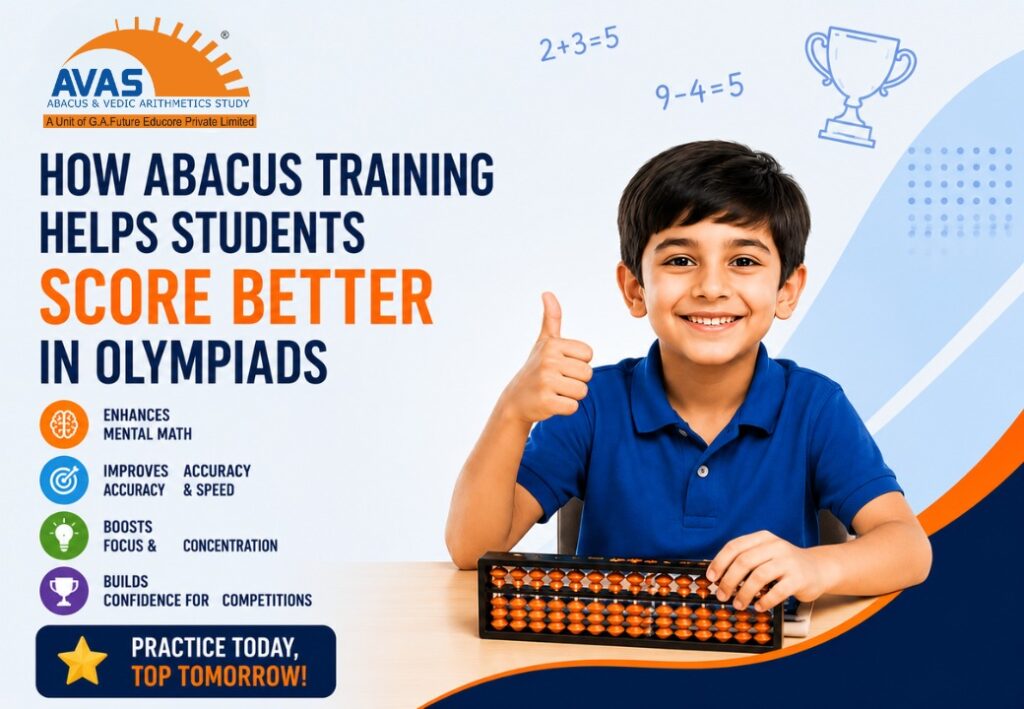
Abacus learning is a method of learning using a solid frame equipped with movable beads (usually the Japanese Soroban or Chinese Suanpan) that represent numbers and are used for calculations.
Children do not use abstract numerical concepts, but instead slide beads along rods to carry out addition, subtraction, multiplication and division. As the students become proficient with the physical tool, they move on to Anzan — a method in which the students can visualize the abacus in their mind and manipulate imaginary beads with greater speed.
- Tactile and Spatial Foundation: converts abstract numeric values into physical, tangible values
- Kinesthetic Engagement: learns from doing, moving, and planned hand-eye coordination
- Visual Representation: forms mental image of numbers by place value
💭 Mental Maths
Mental Maths is a way of doing mathematical calculations without the use of external physical tools, paper or electronics. Mental arithmetic involves mental strategies, properties of numbers, and principles of arithmetic. Common techniques include:
- Decomposition / Partitioning: breaking numbers into manageable units (e.g., 47+28=(40+20)+(7+8))
- Compensation: rounding up or down to simplify, then correcting the rounding
- Pattern Recognition & Number Bonds: using relationships such as combinations to 10, 100 and 1000
Mental maths is firmly rooted in the general school curriculum, and maintains the primary fluency and reasoning about numbers used.
The Main Differences Between Abacus and Mental Maths
Both approaches want to make arithmetic easy to comprehend and quick, but they differ greatly in how they are applied, how much they depend on tools, and how they think.
| Feature | Abacus Learning | Mental Maths |
|---|---|---|
| Primary Tool | Physical abacus frame, progressing to a mental bead frame | Mind alone; supported by written strategies or visual diagrams |
| Cognitive Style | Spatial-visual (picturing bead configurations) | Conceptual-logical (understanding numerical values and rules) |
| Sensory Input | Highly tactile and auditory during early stages | Primarily auditory and conceptual |
Fixed Rules vs. Flexible Strategies
Abacus training is based on specified fixed methods for each bead move. Each addition and subtraction are exact formulas. Mental maths, on the other hand, teaches children to think flexibly — to choose the most efficient mathematical strategy for the numbers being used.
Speed vs. Conceptual Reasoning
By learning how to move beads quickly, children can perform multi-digit addition and long calculations super-fast. Number sense, estimation and realistic reasoning are key aspects of mental maths.
Progression: Abacus
Starts with simple single-digit bead movement → introduces complement formulas (e.g., pairs of 5 and 10) → moves to multi-digit arithmetic → advances to imaginary abacus calculations (Anzan) including square roots and decimals.
Progression: Mental Maths
Starts with basic counting and number bonds → introduces place-value strategies → moves to multiplication short-cuts and fraction handling → integrates into word problems and algebraic thinking.
Is Mental Calculation Possible Without Abacus Practice?
Yes, significantly. Abacus practice is straightforward and is tailored to move towards mental arithmetic. Children physically calculate in their early training. As they progress, the teachers prompt them to do the calculation without touching the frame by seeing the beads in space. This method of mind mathematics helps students to move from physical abacus to mental computation.
Studies of mathematical cognition show that the use of visual representations of a number supports the learning gap in early abstract representation. The Stanford Graduate School of Education's report on the role of visual and spatial involvement in early mathematical knowledge suggests that visual and spatial engagement is a strong facilitator of early mathematical understanding.
The Visual Bridge Helps To:
- Avoid using fingers to count
- Improve memory of place and focus
- Offer a real-life example of multi-digit arithmetic
Which Method for Different Ages?
It depends on your child's age, current skills and learning needs when deciding on Abacus or mental maths.
Abacus Learning
- Help children to understand numbers using beads and visual activities
- Develop simple counting, number recognition and number sense
- Promote active learning with engaging activities
Abacus & Mental Maths
- Practice by developing speed and accuracy
- Present mental calculation strategies and number patterns
- Investigate Vedic Maths techniques to complement school mathematics
Mental Maths & Advanced Problem-Solving
- Work on flexible number strategies, estimation and mental calculations
- Improve logical reasoning and problem solving skills
- Use mathematics to solve word problems, algebra and test questions
Keep in mind that the age categories are suggestions, not guidelines. Select a method that is appropriate for your child's learned abilities, interests and learning objectives.
Questions Parents Should Ask Before Enrolling
Before making a decision about enrichment program, ask these following important questions:
What is my child's current learning style?
Is my child more of a "hands on" learner or does he or she work better with abstract ideas and number tricks?
What are our main objectives?
Do you want to develop basic concentration and quickness (Abacus), or do you want to increase grades at school and standard word-problem solving (Mental Maths)?
What is the practice time allowable per week?
To master Anzan a daily practice is required to develop the muscle memory for training with Abacus (15–20 minutes).
Does the programme fit into my child's school programme?
Make sure to make sure techniques don't muddy your child's thinking when they are solving written math problems in school.
Do Children Learn Both Ways?
Yes. A balanced approach to mathematical learning is to incorporate the use of Abacus and mental math methods.
Early Years (Ages 4–7): Begin with Abacus practice to build a foundation of visual spatial awareness, working memory and fast arithmetic speed.
Later Primary (Ages 8+): Develop a wider range of mental maths learning strategies, including estimation, numeric decomposition and Vedic Maths classes to increase conceptual understanding and ensure curriculum coverage.
The two approaches can be used together and allow for the support of speed and visual calculation skills in the development of powerful conceptual reasoning.
Final Takeaway
Abacus is not 'better' than Mental Maths, and vice versa — they have different developmental needs:
🧮 Choose Abacus Learning if your child…
- Is young (ages 4–8)
- Prefers tactile/visual learning
- Requires assistance with focus and memory
- Enjoys structured and concrete tools
💭 Choose Mental Maths if your child…
- Is older (aged 8+)
- Already knows their place value
- Prefers flexible problem-solving methods
- Requires quick support with school maths tests and word problems
Aligning the learning approach with your child's mental development will help you develop a solid lifelong mathematical foundation. If you're interested in structured teaching and learning, you might try mental maths workouts for children and targeted programs such as special Abacus classes for children.
Find the Right Programme for Your Child
Our Abacus and Vedic Maths classes are designed to match your child's age, learning style, and goals — building real maths confidence step by step.
Explore Abacus Classes →