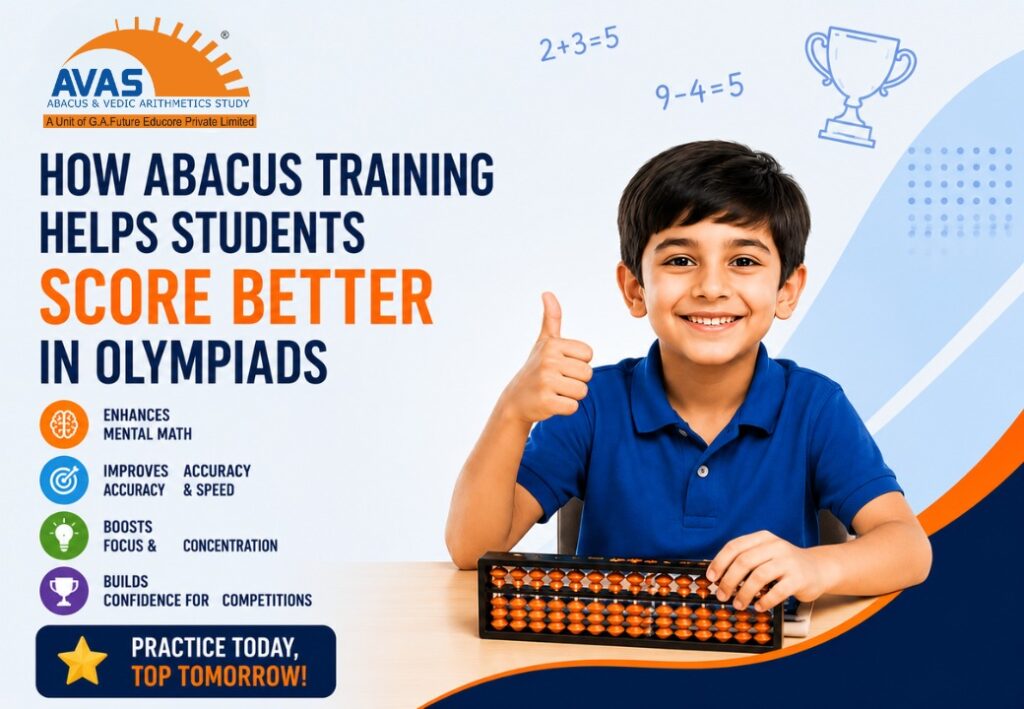

My Child Is Good at School but Slow at Calculations: Can Abacus Help?
For many parents whose child does very well in class and grasps all lessons, gives correct answers to questions and excels at school. Yet when it comes to calculations, the child takes too much time for them. Simple calculations may involve extra thinking, counting several times or even require parental help.
If the above situation seems familiar to you, there is nothing to be upset about straight away. Each child learns differently and at their own pace. If your child is slow at maths, it doesn't necessarily mean that he/she is poor at math or has any lack of skills in it. Some children need more practice and confidence.
One of the options to try would be the abacus classes for children.
Why Some Children Understand Maths but Calculate Slowly
This is something that is often faced by many parents. A child who solves mathematics problems slowly is not always a poor mathematician. At times a child knows the concepts and just needs more practice.
Each child learns at his/her own pace. Instead of rushing the child into solving the problems fast, there are other ways to help them.
Calculation Speed vs Mathematical Understanding
Speed Alone Is Not Enough
Parents feel delighted when their children solve maths questions quickly. But a child may solve maths questions slowly and still comprehend the concepts very well. Pressuring a child makes him nervous and less confident about his mathematical skills.
Comprehension Comes First
Comprehension of mathematical concepts is just as crucial as coming up with the right answers. A child that performs badly in maths needs to have more practice in basic mathematics — not to be pressurized. Allowing time for comprehension and understanding helps a lot.
How Abacus Learning Works
🧮 Learning Through Beads and Visual Representation
Abacus classes help to get an idea about numbers through basic beads. Abacus soroban tools are structured with middle beads and lower beads. These beads are useful for counting and for solving sums around the minus complements and plus complements.
💭 Moving from Physical Beads to Mental Visualisation
Children use the physical beads for calculation and for solving the sums. After some time, with attention and continued practice, they solve sums without physical beads — through the imagination of beads, position, and calculations with the help of mind visualisation. This boosts maths confidence in children.
✅ Developing Accuracy Before Speed
In abacus learning, accuracy comes before speed. Children must first understand bead movement and calculation methods. When they become comfortable, they then work on speed.
Can Abacus Help Every Child?
Yes, abacus learning benefits many students — but all students are different, so it depends on how much time each child takes to learn. Abacus helps in mental calculations, speed, and accuracy. The key is to be patient and allow each child to progress at their own pace.
How Parents Can Support Progress at Home
Here are some suggestions:
-
1Practice calculations for 10–15 minutes every day.
-
2Practice calculations using games and puzzles involving numbers and counting.
-
3Start with accuracy before speed.
-
4Introduce Abacus lessons to enhance understanding and visualisation of numbers.
-
5Congratulate children for their achievements no matter how small they are to boost their confidence in maths — it's also best for mental arithmetic for kids.
-
6Practice mental calculations appropriate for your child's level.
-
7Do not compare your child with other children in terms of development.
When Slow Calculations May Need Additional Assessment
Signs That More Help May Be Needed
In case the child is slow at maths and finds it difficult to do any kind of calculations even after being regularly exposed to them, there is no harm in getting an extra assessment done. This could mean that the child needs some time to learn numbers, remember mathematics, and even perform the calculation process. There might be some issues that he/she could have faced due to poor learning in the basic stage, attention deficit, or learning disabilities. Parents could get in touch with the child's teacher regarding this matter and if necessary, get in touch with an expert who can assess the problem.
Every child learns mathematics at a different pace, and slow calculations do not necessarily mean a child is weak at maths. With regular practice, patient guidance, and the right learning approach, children can gradually develop better accuracy, number understanding, and confidence. Abacus classes for children can offer a structured way to practise calculations through visual learning and mental arithmetic. However, the focus should remain on understanding numbers rather than speed alone. Parents can support progress by encouraging daily practice, celebrating small achievements, and creating a positive learning environment.
Help Your Child Build Calculation Confidence
Our Abacus classes are designed to build accuracy, mental visualisation, and number confidence — at every child's own pace.
Explore Abacus Classes →