

In the contemporary virtual world, there is no need to make learning math homework. As the online mathematical games that require mental calculations emerge, children are able to train their calculating abilities and play at the same time. These interactive math games are a combination of speed, strategy and excitement—they assist the students in the development of number sense, confidence, and quicker thinking.
Online games are a strong supplement to parents and educators, who are also interested in developing mental math and other structured programs, such as Abacus training and AVAS Prodigy.
We will discuss the effectiveness of math games, why they are effective and the most effective ones based on age.
The Reasons as to Why Online Math Games Work
Interactive Learning Involving
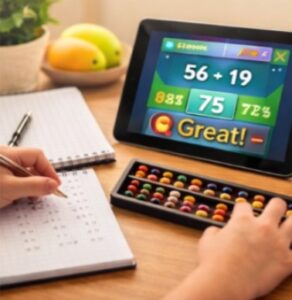
Learning through play is natural to children. Math game interactive activities make boring arithmetic activities interesting and thus learners are motivated.
Confidence Is Built Through the Instant Feedback
Online games display results instantly as opposed to worksheets. This instant feedback aids children in rectifying errors and developing accuracy.
Mental Practice Is the Way to Strengthen the Brain
Quick computations are neural pathway trainers—they have the same effect of enhancing memory, speed, and logical thinking as time goes by.
Fosters Self-directed Study
Children are able to practice independently and make math their routine rather than a stressor.
Why a Math Game Is Good in Mental Arithmetic
Games are not all equally useful. The most effective arithmetic practice applications and websites are about:
- Problems with speed and accuracy
- Adaptive difficulty levels
- Real-time problem solving
- Incentives that encourage hard work
- Patterns that promote the understanding of numbers
Games that involve children doing mental calculations without the use of calculators provide the best skill development.
The Best Math Games Online (Ages 6–8) – Beginners
These are number sense online games, which assist young learners to develop solid bases.
Number Ninja Adventures
- Proficiency: Addition and subtraction with haste
- Reasons why it works: Increases reaction time and pattern recognition and makes math interesting
Counting Quest
- Knowledge: Skip counting, relations between numbers
- Reasons why it works: Builds early number sense that is important to the successful use of mental math
Math Dash
- Skill: Fast + and challenging
- Why it is beneficial: Enhances focus and confidence in the timed conditions
Best among: Early learners taking mental arithmetic.
Best Math Games to Play with Intermediate Learners (9–11 Years Old)

Flexibility and logic are developed by these interactive math games.
Operation Equate
- Skill: Combinations of calculations
- Advantage: Develops logical thinking and accelerates the mental processing speed
Math Puzzle Challenge Arena
- Freedom: Number operations & number patterns
- Pro: Develops flexibility of the mind and being tactical
Fraction Fiesta
- Competency: Fractions and number sense
- Advantage: Enhances theoretical knowledge and rapid fractions
Best: When children are changing from the basics to higher arithmetic.
Mathematics Game: Advanced Math 12–14 (Pre-Teen Years)
Ideal in increasing turnaround and competitiveness.
Num Logic Pro
- Ability: Conceptual ability + quick computation
- Profession: Develops decision-making skills as well as cognitive ability
Multiply Masters
- Skill: Drills of multiplication at a high speed
- Advantage: Enhances the recall speed and accuracy
Mental Math Olympiad Arena
- Skill: Mixed operations time-based
- Advantage: Mimics the competition type of mental challenges
Ideal: Students who are going to higher academics and Olympiads.
Online Games: How to Play Effectively at Home
In order to achieve actual results, not just entertainment, observe the following rules:
- Very short practice sessions (10–15 minutes a day) are better than long and sporadic practice
- Talk about math in everyday life (shopping totals, time, measurements)
- Monitor progress in a soft manner without coercion
- Focus on short-term achievements to create momentum
It is the consistency that counts rather than the time.
Add Games to Abacus and Mental Math Training
Math games on the Internet become the most effective when they are combined with purposeful learning.
How Abacus Helps
- Acquires visualization abilities
- Boosts calculation speed
- Enhances recall and attention
How Games Support It
- Reinforce number patterns
- Become more flexible in solving problems
- Make practice fun
When combined = Thinking quicker and understanding better and being confident.
Balanced learning, which is mastery of skills off-line and reinforcement online, is achieved by programs such as AVAS Prodigy along with interactive games.
Indications Your Child Wants a Break or a New Game
Noticing these signals? Perhaps it is time to change it around:
- Frustration or boredom
- Loss of interest quickly
- Decreasing accuracy
- No visible progress
Motivation is usually regained by changing the difficulty of the game or its format.
Overall Perspective

Overall, I saw a great film about math and how it can be an engaging experience.
Mental arithmetic is not only used in exams but it is a lifetime skill that helps in supporting:
- Faster problem solving
- Better academic learning
- Increased assertiveness about life
When children play online math games in their mental arithmetic with the help of structured resources like Abacus training, learning becomes effective and fun.
Learners should develop math skills on their own, not be pressured.
Frequently Asked Questions
Speed, number sense, and adaptive challenge mathematical games, such as Math Dash, Multiply Masters, and Operation Equate.
: Yes! Fast calculations are done repeatedly which enhances memory, accuracy and speed of thinking.
10–15 minutes a day is the best to ensure gradual improvement.
Yes—students tend to be more confident, faster in calculations and even improve their test scores.