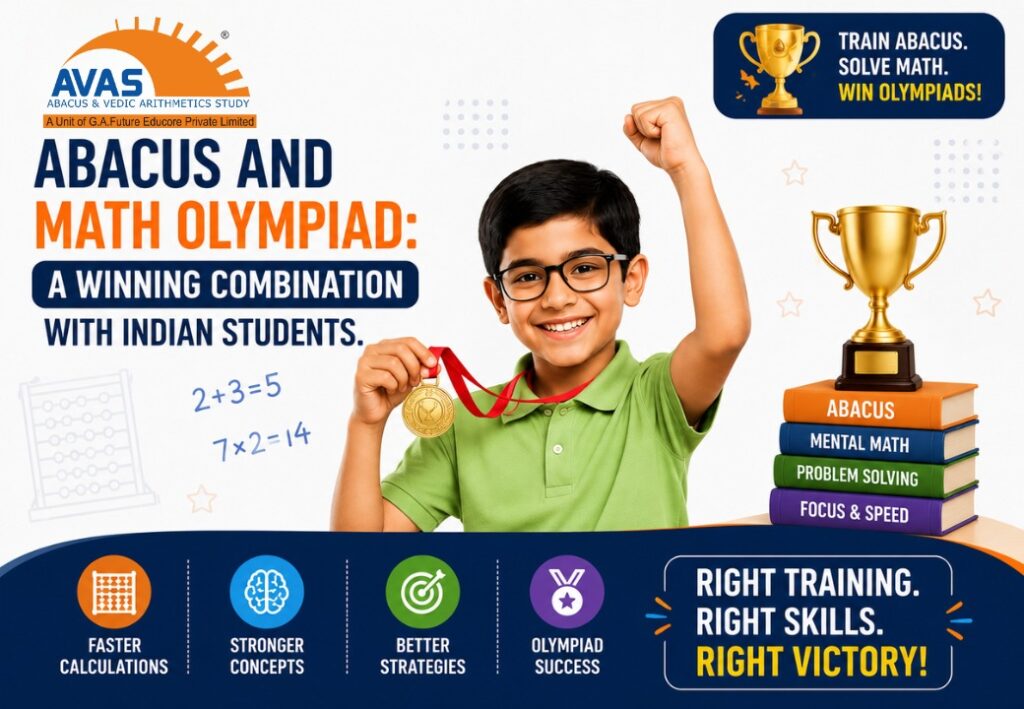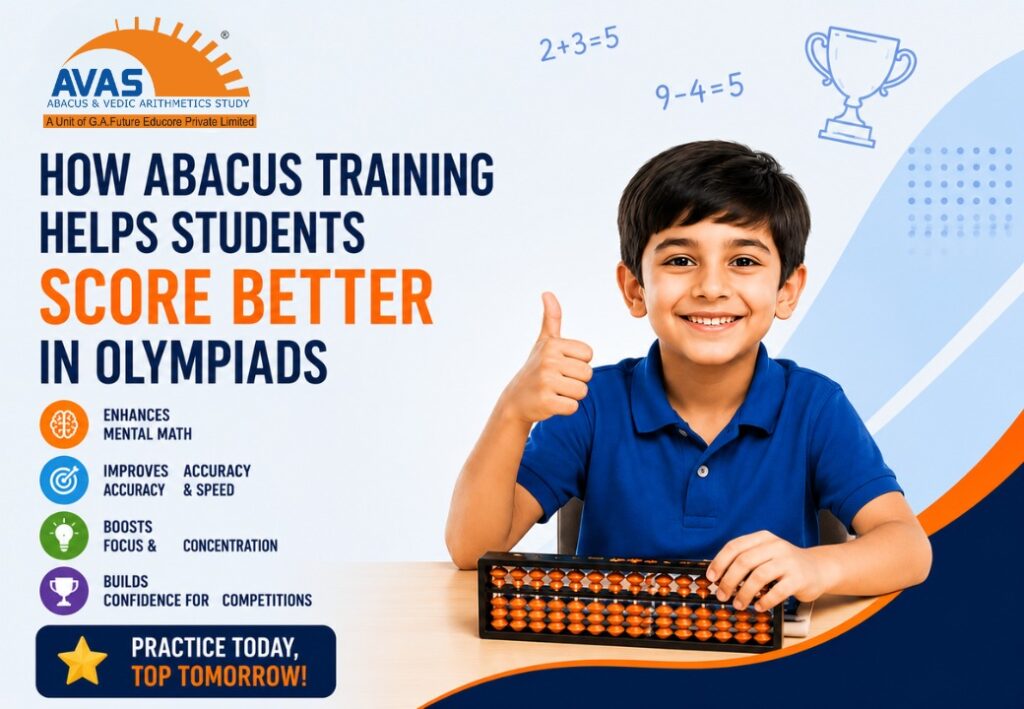

Indian competitiveness in mathematics exams is not only created to test the knowledge of the syllabus but also to select students with good logical thinking, good number sense and high-order problem-solving skills. The Indian Math Olympiad model is organized so as to closely develop mathematical thought—starting with the challenges at schools and moving on to international contests.
Knowing this structure at a young age can make the preparation of Olympiads much easier for the parents and the students. What is more important is that the development of fundamental skills such as mental calculation, visualization in mathematics and clarity of concepts at a tender age gives a solid base for success in the long run.
We can divide the Olympiad levels and preparation strategies according to age and how the training with Abacus is an influential factor in Olympiad preparation.
Significant Olympiad Stages in India.
Indian Math Olympiad structure is structured in progressive levels, which assist the students to develop and acquire high level conceptual problem solving as compared to simple reasoning.
School-Level/Foundation Olympiads.
These are held by the private Olympiad bodies and are the entry level for the young learners.
Significant Olympiad Stages in India
Indian Math Olympiad structure is structured in progressive levels, which assist the students to develop and acquire high level conceptual problem solving as compared to simple reasoning.
School-Level / Foundation Olympiads
These are held by the private Olympiad bodies and are the entry level for the young learners.
Key Focus Areas:
Basic arithmetic
Patterns of numbers and sequences
Logical reasoning
Word problems
These Olympiads are meant to initiate curiosity and develop problem-solving skills in early Olympiads. Classes with 1–4 students are particularly advantaged by getting exposed to problems that are fun but challenging and that can enhance the development of number sense.
Regional / State-Level Olympiads
There is more competition at this stage and time management is very essential.
Key Characteristics:
Questions of increased difficulty
Multi-step problem solving
More rapid mental computations were needed
Application of the concepts outside of textbooks
Mental math and strong fundamentals are significant contributors to performance in this case.
National-Level Olympiads
These tests are theory-based and require accuracy.
Students must demonstrate:
Advanced logical reasoning
Closet intellectual insight
Capacity to tackle problems that are not recognizable
Speed with high accuracy
In this case, the ability to visualize in mathematics and good mental agility stand out.
IMO Pathway International Olympiads
This is the most competitive level of math exams.
Key Skills Required:
High-order thinking in mathematics
Strong proofs and reasoning
Deep conceptual clarity
Strategies of high-level problem solving
The students who are at this level usually have years of systematic preparation behind them.
Level by Level Preparation Strategies Olympiad
Early Grades (Classes 1–4)
This step is more about establishing grounds, not stress.
Best strategies include:
The development of good number sense
Promoting the power of mental computation
Aesthetizing math and making it interest-based
Implementation of visualization measures such as Abacus
The training of the abacus at this level makes the children grasp the place value and number associations and also calculate with the help of the mind—a great advantage in the future.
Middle Grades (Classes 5–7)
In this case, it should be a gradual transition of students to systematic Olympiad training.
Focus areas:
Faster arithmetic accuracy
Problems of reasoning in more than one step
Pattern recognition
Application of concepts in new conditions
The use of Abacus together with logical reasoning practice develops speed and power of thought.
Higher Grades (Classes 8–10)
It is strategic and exam-oriented.
Key requirements:
Higher-order Olympiad problem-solving abilities
Time management techniques
The choice of strategic questions
Thinking logically under stress
It is observed that students who are trained in mental math with the help of Abacus can quickly solve problems, commit fewer errors, and tackle complicated problems with confidence.
The Uses of Abacus in Olympiad Training
The role of training provided by Abacus in Olympiad Success
Abacus is much more than a speedster; it builds the mental framework with which competitive math exams can be handled.
Strong Number Sense
Good conceptualization of the place value
Rapid identification of numbers
Improved estimation skills
This is essential to arithmetic and number theory problems of Olympiad level.
Mental Visualization
Mental Visualization of numbers
The multi-step calculations are performed faster
Reduced reliance on manual labour
Mathematical visualization is really helpful in enhancing accuracy and speed.
Speed with Accuracy
Faster question attempts
Reduced careless errors
Increased time to reason on more complex problems
This is essential in competitive math exams.
Better Concentration and Memory
Longer focus during tests
Increased retention of problem steps
Enhanced working memory
Abacus vs Traditional Olympiad Coaching
| Aspect | Traditional Coaching | Abacus Training |
|---|---|---|
| Focus | Problem practice | Core mental skills |
| Speed | Moderate | High |
| Number sense | Limited | Strong |
| Visualization | Rare | Core skill |
| Long-term benefits | Exam specific | Lifelong math strength |
Combining the two would give the best results. Abacus develops the psychological base and Olympiad training provides high-level skills.
Olympiad Topics Maximum Value Added by Abacus
Large number calculations.
Fractions and decimals.
Percentage problems.
Patterns and sequences.
Mental arithmetic rounds.
Time-bound sections.
These are common at Olympiad stages.
At what age should students begin using abacus to the Olympiads?
Ideal age: 5–7 years
Starting early allows:
Good development in number sense
Early mental math mastery
Visualization powers which are natural
Later stress-free Olympiad preparation
Young students tend to achieve better results than other students in middle and high grade.
Frequently Asked Questions
The Indian Math Olympiad system provides the school level, regional/state level, national level and international level such as the IMO pathway.
Yes. Abacus enhances the sense of numbers, mental visualization, speed, accuracy and concentration, as well as confidence, which are important in Olympiad performance.
Classes 1–2 may be used as a starting point of foundation exposure, whereas abacus may be initiated as early as 5–6 years.
No. Abacus develops fundamental skills, whereas coaching is developed with Olympiad-specific principles. The combination of them produces the most results.
It increases the speed of mental arithmetic, minimizes the number of errors made, has better visualization, makes eyes sharper, and establishes a good understanding of numbers.
Final Thoughts
The Indian Math Olympiad system recognizes students who have the maturity of conceptual reasoning, good mental acuity and skill in solving problems in the long run.
Although Olympiad coaching is an advanced training, Abacus training is the strong foundation of the mind contributing to success on all the levels starting at the school level competitions to national and international levels.