
What makes Olympiads Exams Different From School Exams?
Majority of parents believe that passing mathematics well in school is a simple way of preparing a child to take Olympiad tests. It is one of the most fundamental misunderstandings. Olympiads do not consist of copying the learned formulas or using standard ways. They test how a child thinks.
Olympiads do not focus on:
- Reasoning as opposed to memorization—questions are created to be conceptualized rather than memorized.
- Multi-step problem solving— It is one problem that may take 3-5 layers of thinking to solve.
- Careful pressure Speed- Time constraints are very short, and errors in careless calculations are severely punished.
This is precisely the reason why conventional coaching in most cases cannot work. The cognitive skills required in Olympiads cannot be crammed.
Why Strong Fundamentals Matter in Olympiads
Development of number sense is the core of Olympiad success. The children who fail in Olympiads do not normally fail because they are not intelligent, but fail to have clarity in basic numerical concepts.
The fundamentals are strong and include:
- Strong knowledge of the place value.
- Familiarity with mental mathematical skills.
- Instinctive estimation and validation of answers.
Some examples of the many Olympiad errors caused by weak foundations include:
- Misjudgments in the initial step.
- Slow calculation speed
- Getting lost when solving problems in steps.
Abacus training fills these gaps directly, as it enhances the early numerical intuition.
How Abacus Training Strengthens Olympiad Skills

Faster Mental Calculation
This is because Abacus training prepares the brain to be able to calculate things mentally fast and accurately. As children advance to mental images out of physical beads, they:
- Minimize use of pens and papers.
- Large calculations can be done correctly within seconds.
- Higher-order thinking with free mental capacity.
In the case of Olympiads, such speed will enable students to tackle more questions with confidence.
Visualization & Spatial Thinking
Visualization in math is one of the strongest advantages of Abacus. Learners are taught to visualize numbers, motions, and changes in their minds.
This visualization:
- Improves the ability to recognize patterns.
- Read more elaborate Olympiad problems quicker.
- Sequences, logical puzzles: Strengthens the spatial intelligence required to solve the sequence and logical puzzle.
Olympiad toppers do not reason more; they know answers, and they see answers.
Improved Memory and concentration
Practicing with an abacus develops attention. Students need to follow the motion of beads and change of numbers and sequences in their minds: boosting:
- Focus during long exams
- Working memory
- Multi-step logic retention.
This has a direct positive effect on Olympiad problem solving under pressure.
Abacus vs. Traditional Olympiad Coaching
| Aspect | Abacus Training | Traditional Coaching |
|---|---|---|
|
Core Focus
|
Skill development
|
Syllabus coverage
|
|
Long-Term Benefit
|
Across all grades |
Exam-specific |
|
Calculation ability |
Calculation ability
Mental & Fast
|
Pen-paper development
|
|
Confidence
|
Skill-led |
Score-led |
Abacus is not meant to substitute Olympiad coaching; it just enhances it by making sure that the brain is ready to learn more difficult concepts effectively.
Olympiad Topics Where Abacus Makes a Difference
Abacus training has a direct contribution to several Olympiad areas, such as
- Arithmetic and number operations.
- Speed math and estimation
- Patterns and sequences
- Rational puzzles and questions involving reasoning.
When the students are trained in Abacus, they look at these subjects in a clear manner rather than with fear.
When Should a Child Start Abacus for Olympiads?
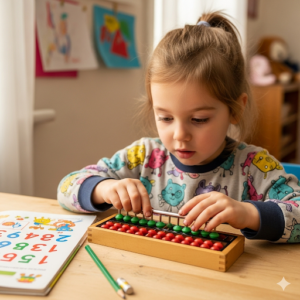
This is because the ages between 5 and 7 are the best times to start Abacus training. At this point, the brain is the most accommodating to numerical visualization and pattern construction.
Starting early:
- Develops skills when one is not under academic pressure.
- Builds an incremental benefit in each consecutive year.
- Prevents math anxiety later.
Stress is aggravated by late preparation. Confidence is gained by early preparation.
Confidence: The hidden Olympiad Advantage
Confidence is not a motivational talk; it is a result of competence.
Students who have been trained on abacuses indicate:
- Reduced exam anxiety
- Better time management
- Composed and rational decision-making.
In situations where calculations can be easily made, the mind can remain relaxed even in a competitive situation.
Real Impacts of Abacus Training on Olympiad Advantage
Students having organized Abacus training always demonstrate:
- Faster attempt rates
- Fewer calculation errors
- Increased performance in international and national Olympiads.
This isn’t coincidence. It’s cognitive conditioning.
Conclusion
Training in using an abacus is not a quick way to the Olympics medals. And it is something greater, a principle of mathematical thinking.
If it is sustainable success and not pressure towards success, as a parent, the Abacus training will provide a definite advantage: skills that endure, confidence that compounds and performance that reflects real understanding.