Abacus Training Program in 2026: What's Changed and What to Look For
You're not completely wrong if you picture an abacus class as a group of children sitting around a table while a teacher calls out numbers and has them move beads. In 2026, however, that is just the starting point.
The abacus itself hasn't changed. Children should still learn bead values, practise in stages, build accuracy, and gradually work towards mental calculation and visualization. What has changed is how programs are delivered, how teachers are trained, what parents expect, and how training providers establish credibility.
These changes matter to parents evaluating classes, teachers considering certification, and future trainers choosing a program. What once felt cutting-edge can now feel outdated if it only offers one delivery option, limited teacher support, and no verifiable certification. Let's look at what is genuinely different in 2026 — and what remains the same.
Why the Abacus Training Landscape Looks Different
For years, the abacus education model was straightforward: students attended a physical center once or twice a week, worked through printed books, and moved up levels based on tests.
As families and educators became more familiar with digital learning, training organizations had to learn how to teach remotely, share resources digitally, and support teachers who were no longer in a traditional classroom environment. That shift has continued well beyond the pandemic period.
The National Skill Development Corporation (NSDC) has noted that its training ecosystem has shifted towards virtual delivery, with partners actively developing digital tools and blended-learning formats for trainers. At the same time, broader trends in Indian education — particularly the thrust of NEP 2020 towards skill-based, foundational learning — have raised the bar for what parents and institutions expect from supplementary education programs.
The result is a market where the quality of delivery, certification, curriculum, and trainer preparation now matter far more than they did just five years ago.
What changed is not the abacus — it's what a quality program around the abacus now looks like.
What's Changed vs. What Hasn't
🔄 What's Changed in 2026
- Hybrid delivery (phygital) is now the norm
- Multi-skill bundling replacing single-subject centers
- Stricter certification and accreditation standards
- Alignment with NEP 2020 and government skilling frameworks
- Digital practice portals and progress tracking tools
✅ What Remains the Same
- Physical soroban-style abacus as the core instrument
- Bead → visualization → mental calculation progression
- Ideal start age: 5–13 years
- Daily practice (10–15 minutes) is still essential
- Tactile, hands-on learning remains most effective

The Four Key Changes in Abacus Programs
Hybrid Delivery: Now the Norm, Not the Exception
The complete divide between offline centers and digital-only apps has largely disappeared. In 2026, most quality abacus programs operate on a "phygital" model combining:
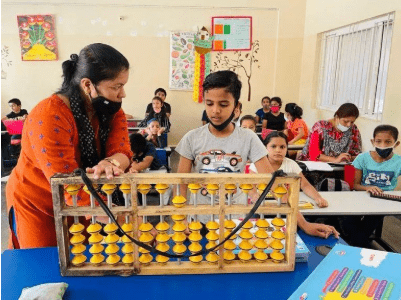
- Physical in-person sessions — Children use the traditional abacus kit under direct instruction from the teacher, correcting finger positioning, developing tactile memory, and building form
- Digital practice portals — Gamified web or mobile platforms for daily practice drills between physical classes, with automated timers and instant progress tracking
This hybrid model reduces passive screen time while maintaining the regular, bite-sized daily practice necessary for mental visualization to develop.
Multi-Skill Bundling Over Single-Subject Centers
Standalone abacus-only centers are declining. Major training providers have moved towards multi-skill bundling to offer more comprehensive cognitive development and retain students for longer:
- Vedic Maths — Introduced at higher levels to complement bead-based mental methods with visual-algebraic techniques
- Junior Abacus — For early childhood cognitive development, often paired with phonics and early literacy
- Handwriting and Spatial Reasoning — Fine motor skill development linked to bead manipulation
- Robotics and STEM Basics — Applied logic environments for older abacus graduates
For parents, this means holistic cognitive development in one place. For teachers and center directors, it means keeping pace with current expectations around multi-skill teacher training.
Increasing Requirements for Certification & Accreditation
The market has seen a flood of informal operators offering low-cost certifications. In response, parents and prospective teachers are increasingly looking for credibility they can verify and trust. There is wider use of standardized, multi-tiered assessment frameworks replacing simple "certificates of completion."
Established institutes now support their programs with:
- National standardized assessments for each curriculum level
- ISO-certified quality management processes
- Government-linked frameworks such as NSDC Skill India certification
This added accountability protects families from under-prepared providers and ensures a student's progress is recognized beyond one local center. For a detailed guide on what recognized certification actually means, see: Government-Certified Programs: What to Look For.
Alignment with NEP 2020 and Government Skilling Initiatives
Government policy has meaningfully influenced what parents and institutions now expect from supplementary learning. The National Education Policy (NEP 2020) explicitly emphasizes Foundational Literacy and Numeracy (FLN), experiential learning, and early-childhood cognitive development as national education priorities.
Alignment with government-related frameworks like Skill India and the National Skill Development Corporation (NSDC) has become an important trust signal. Abacus training is increasingly viewed as a systematic cognitive development framework — building working memory, visual-spatial awareness, and concentration — in line with national educational objectives rather than simply a fast-calculation trick.
AVAS programs through IIVA are positioned as NSDC Skill India Approved Training Partners and NCERT Content Partners, directly aligned with these policy priorities.
Explore AVAS — Built for 2026's Abacus Training Standards
NSDC-certified, hybrid-ready, and combined Abacus + Vedic Maths — meeting every standard that defines quality abacus training in 2026.
Explore AVAS Programs
What Hasn't Changed
Despite the evolution in delivery formats and bundling, the core of abacus instruction remains exactly as it has always been:
The Physical Soroban
The physical abacus frame is still the foundational instrument. No app replaces the tactile bead experience for beginners.
The Learning Progression
Physical beads → visual bead imaging → rapid mental calculation. This sequence hasn't changed and cannot be shortcut.
The Ideal Age Window
Ages 5–13 remain optimal — the period when the brain is most malleable and dual-handed tactile learning is most effective.
Daily Practice
10–15 minutes of daily practice remains non-negotiable. No platform or smartboard replaces consistent daily repetition.
Visualization as the Goal
The end goal remains mental visualization — calculating using an imaginary abacus without any physical tool.
What to Look For in a 2026 Abacus Training Program
Given the changes described above, here are the key questions to ask before enrolling your child or signing up as a franchise partner:
2026 Program Evaluation Checklist
- Delivery format — Is the hybrid split (in-person vs. online) clearly defined, or vaguely described? Can you attend a trial session in both formats?
- Curriculum depth — Does abacus stand alone as a core subject, or is it a small add-on within a larger package? Is Vedic Maths included in the progression?
- Certification source — Is the certification traceable to a recognized authority — preferably NSDC or Skill India? Or is it an institute-level certificate only?
- Instructor training — Are teachers formally certified to teach abacus, or are they simply running pre-packaged licensed material?
- Operating history — Is this a provider with a demonstrated track record, or a new entrant with strong marketing but limited proof of outcomes?
The Next Steps for Abacus Education
The direction of abacus training in India points towards greater integration with mainstream schools and structured skill centers. Schools striving to meet NEP FLN requirements are increasingly incorporating structured abacus classes as part of the early-primary curriculum rather than treating them solely as an after-school option.
For educators and those considering becoming a center owner, the future favors multi-skilled instructors. Single-subject training is giving way to all-in-one training qualifications that cover Abacus, Vedic Maths, and early childhood literacy tools within a single certified program — making today's multi-skill training investment even more valuable long-term.
Frequently Asked Questions
Is abacus training still relevant in 2026?
Yes. While everyone has access to a digital device, abacus training is not about calculating numbers — it's about brain development. Tactile practice is a screen-free method for strengthening working memory, visual-spatial logic, concentration, and confidence with numbers. These cognitive benefits remain just as relevant in 2026 as they were decades ago.
What's the difference between older and newer abacus training programs?
Older programs were based on rote practice with a single printed workbook. Modern programs combine physical bead instruction with digital practice portals, offer multi-skill curriculum bundling (Abacus with Vedic Maths, Phonics, or STEM), and provide formal government-backed or ISO accreditation. The methodology is the same — the delivery, support, and credibility standards are significantly higher.
Is online abacus training as effective as offline in 2026?
The hybrid model — combining live in-person technique sessions with digital daily practice — is usually the most effective approach. Purely online teaching can miss finger-placement errors in young beginners, particularly at the foundational levels. The best contemporary structure uses face-to-face small group sessions for physical technique, with online guided practice and speed exercises between classes.
Start Your 2026 Abacus Journey with AVAS
NSDC-approved, NCERT-aligned, hybrid-ready — structured Abacus and Vedic Maths programs for students and teacher training for educators. Book a free trial class today.
Explore AVAS Programs